

Only a week later and there’s already been a lot of ink spilled on the Canada-Alberta Memorandum of Understanding that covers economic and energy cooperation.
And it’s generated wildly different reactions.
Here are my thoughts on what the MOU means, for better and worse. There are merits to collaboration, of course. At the same time, talk of a grand bargain feels like déjà vu, and this government needs a clear-eyed ambitious climate plan.
You can read the full text below.
It’s my own honest assessment (seems fitting after this article in The Walrus), but worth acknowledging there have been a range of different takes so far. The National Observer’s Max Fawcett, Evan Scrimshaw at Unscripted, and Clean Prosperity’s Michael Bernstein all offer more positive takes. Meanwhile, it not only prompted Guilbeault’s resignation, but those of two top climate advisers on our Net Zero Advisory Body. And former Minister (and recent podcast guest) Catherine McKenna has reinforced these concerns too.
Recent Uncommons episodes
Best-selling author, historian, and progressive activist Rutger Bregman joined me to talk about his new book Moral Ambition (and new school of the same name), a call to arms to stop wasting one’s talent and dedicate oneself to solving big challenges.

Award-winning journalist and author Tanya Talaga joined us for a live event focused on her recent book The Knowing. It’s a deeply personal story in which she traces her own family’s history, and it is a story of Indigenous people in Canada, injustice, reclamation, and outlasting.

Upcoming guests include the amazing troubadour Raffi and Indigenous leaders Ava Hill and Willie Littlechild. If you have suggestions for guests or topics, you can always reach us at info@beynate.ca
In case you missed it
I wrote about the reaction to my budget reaction here, and reflected on the role of MPs and reasonable disagreement in our politics.
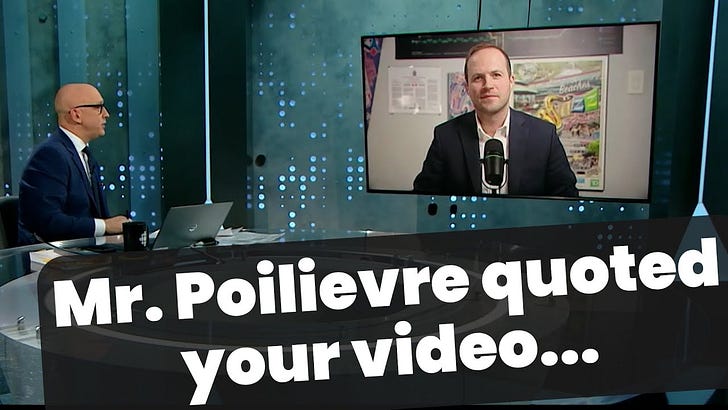
And The Walrus also wrote a profile about our approach to politics, highlighting the benefits and challenges of authenticity and honesty as we work to make our politics about ideas. And no, not a usual headline/question for a politician ha.

Grand bargains, déjà vu, and a review of the Canada-Alberta MOU
What should we make of the memorandum of understanding between Canada’s Prime Minister and Alberta’s Premier?
Well, it’s certainly caused wildly different reactions across the spectrum. Danielle Smith was booed by her base at mere mention of the MOU, and environmental champion Steven Guilbeault resigned his cabinet post based on his strong opposition to the deal.
So what does the deal do exactly?
On the one hand, at a high level, it’s a collaborative document in a moment when national unity is critical. It’s an attempt by the feds to buy political peace with Alberta, to address a sense of western alienation, to diversify our conventional energy exports from the US, and yes, to secure a less confrontational path to some climate action.
But less action than one might have expected, if we’re being honest. We gave up a lot - probably too much - for any short-term peace. It represents climate backsliding and a distraction from the ambition we need.
In fairness, let’s start at the start. The MOU’s preamble tells us that Alberta and Canada are “committed to achieving net zero greenhouse gas emissions by 2050”, establishing Canada as a global energy superpower,” and respecting Indigenous rights-holders.
It then sets out a series of mostly laudable objectives, from cutting red tape to providing economic opportunities for Indigenous communities. The main and obvious tension is the goal to “increase production of Alberta oil and gas while simultaneously reaching carbon neutrality.”
Is it possible? Well, in theory, maybe.
The idea is that so long as the world relies on fossil fuels, Canada should reap the economic benefits. And there’s a logic to that, of course. Better us than the United States or other countries with poor human rights records.
But it’s also true that it’ll be a real challenge to make the intensity of oil sands emissions globally competitive for those final barrels. Knowing this, the MOU ties a potential new pipeline through northern BC directly to a massive carbon capture and storage project. The downside is that it’ll cost billions in public subsidies, and experts call the tech “expensive, unproven” and a distraction “from global decarbonization efforts while allowing the oil and gas industry to conduct business as usual.”
The truth is that in a future net zero world, there isn’t a strong business case for new fossil fuel infrastructure today. The oil and gas sector is already our largest single source of emissions, and a significant expansion of production is likely only viable in a non-net zero world.
Which seems to be what the MOU is betting on because that’s what it commits to - a significant expansion of oil production and export of at least one million barrels a day above the status quo of over 4 million barrels, through a combination of a new potential pipeline and expanded capacity on Trans Mountain. The only trans rights Premier Smith seems to support.
Still, it’s fair for the private sector to bet on that world, and the feds have said that there won’t be public money for any new pipeline. That’s the right answer and we should ensure that it doesn’t happen indirectly through loan guarantees.
It’s also fair for governments to approve weak private sector bets so long as the environment and Indigenous rights are protected and respected. Which is where the proposal will likely fall down, in the face of BC and Indigenous opposition.
At the same time, while companies are free to bet on runaway climate change, it’s incumbent on governments to take ambitious climate action seriously. Does the MOU get us there? Not nearly enough.
On the positive side of the ledger, Alberta commits to the construction of large transmission interties with BC and Saskatchewan. That’s good.
Alberta also commits to an industrial carbon price of $130 per tonne and methane rules in exchange for Canada doing away with the oil and gas emissions cap and giving Alberta a carve out from national clean electricity regulations.
The industrial price of $130 is well below the $170 federal benchmark and the methane regs have been ready to implement for a year now, with a view to slashing 75% of emissions by 2030. That timeline’s now pushed back to 2035.
The Canadian Climate Institute warned that the MOU could trigger a race to the bottom on climate policy and the Pembina Institute called it a “missed opportunity” opening the door to delayed climate action and investor uncertainty.
It’s hard to understand where on the path to net zero all of this leaves us. After dropping the consumer carbon price, winding down Greener Homes, and pausing the EV mandate, there were already gaps in our plan that hadn’t been made up.
And now there are additional gaps to fill. So, what’s the plan? We can’t manage what we don’t measure.
And yes, I understand that the instinct for someone who had a front row seat to Brexit is to work together, to get buy-in from provinces, to establish a Grand Bargain as it were. Of course it is.
But we gave up a lot - probably too much - for whatever short-term political peace we’ll benefit from. After all, the last grand bargain was the $35 billion Trans Mountain pipeline in exchange for Alberta’s commitment to carbon pricing and climate action, in part to address western alienation.
And almost a decade later, it’s déjà vu all over again.
Except with even less time to act with the sense of urgency required to build the sustainable future we deserve.
The energy transition will happen with or without us, and we can’t afford any distractions. We need a clear-eyed ambitious plan for net zero to become a clean energy superpower and because the carbon budget won’t balance itself.
As a wise former central banker once wrote: “Value in the market is increasingly determining the values of society. We are living Oscar Wilde’s aphorism - knowing the price of everything but the value of nothing - at incalculable costs to our society, to future generations and to our planet.”
Or take this from our platform in the spring: “as we build the strongest economy in the G7, we cannot lose sight of the impact our choices will have on our children and grandchildren; we must always be mindful of long-term sustainability and the kind of economy and environment we want for them.”
Words and promises we would do well to heed.
It’s a non-binding MOU so a lot of water has to flow over the dam before we get an idea of what it will actually mean down the road. It does, however, quite clearly confirm that Carney’s enthusiasm for addressing climate change is illusory. It’s an act. It’s virtue-signalling, just as is his support for a Palestinian state while he steadfastly declines to recognize the Israel genocide.
For those of us with kids and grandkids, Carney is working hard to prove that our initial favourable impression and optimism about his tenure was misguided. He’s proving to care more about corporate Canada than he does about Canadians. And we now know that we can take nothing he says at face value. That’s discouraging.
Im very sad about this agreement. This province has an authoritarian leader!